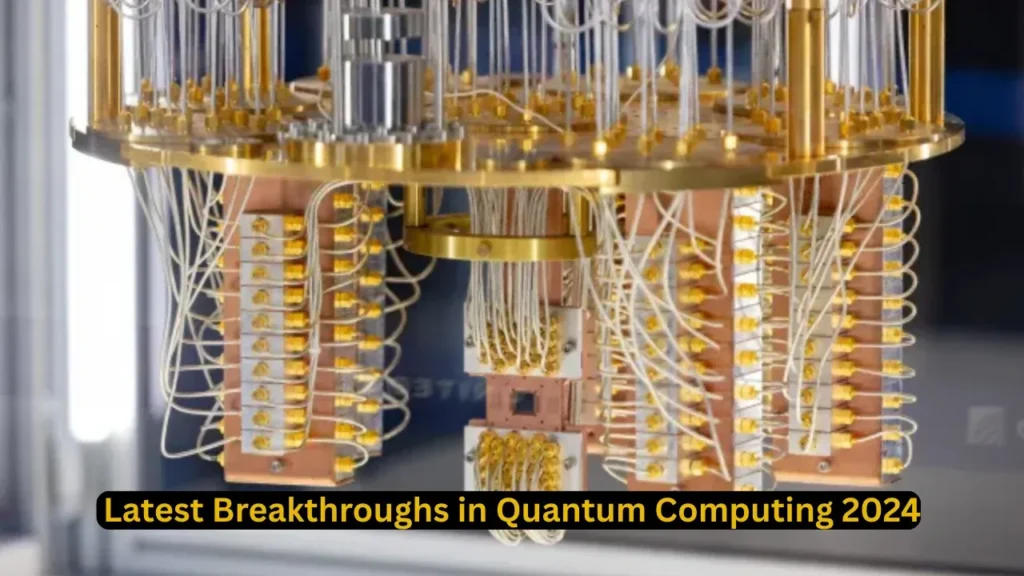
Latest Breakthroughs in Quantum Computing 2024
Definition: In 2024, quantum computing made major strides in hardware and algorithms. Landmark advances include Google’s new 105-qubit Willow chip, IBM’s 156-qubit Heron processor, and Quantinuum’s enhanced trapped-ion H2 system. These breakthroughs – along with practical error-correction and novel architectures – have together marked 2024 as a turning point toward useful quantum advantage.
Quantum computers use qubits (units that can be 0, 1, or both via superposition) instead of classical bits. They exploit entanglement and interference to tackle certain problems (like factoring or simulation) far faster than classical PCs. 2024’s news moved quantum tech closer to reality: large qubit chips ran complex benchmarks in minutes, and real-time error correction (QEC) became practical.
💡 Quick Fact: Google’s 105‑qubit Willow chip (announced Dec 2024) solved a “random circuit sampling” task in under 5 minutes – a calculation that would take a classical supercomputer roughly 10<sup>25</sup> years!
What Is Quantum Computing?
Quantum computing is an emerging field of computing based on quantum mechanics. Instead of bits (0 or 1), it uses qubits which can exist in a superposition of 0 and 1 simultaneously. Multiple qubits can become entangled, so that measuring one affects the others instantly. By orchestrating interference between quantum states, QC can amplify correct outcomes and cancel errors, potentially solving problems in chemistry, optimization, cryptography and more that would stump ordinary computers.
Unlike conventional processors, quantum hardware is fragile: qubits decohere quickly and gate operations introduce errors. That’s why 2024’s breakthroughs focused on making qubits more stable, correcting errors, and carefully controlling larger chips – essential steps toward practical quantum computers.
Why 2024 Was a Turning Point
2024 shifted quantum computing from theory to practice in several ways:
- Error Correction Milestone: Google’s Willow chip showed “below-threshold” scaling, cutting error rates by half as more qubits were added. In other words, Willow’s error-correction improved exponentially with size – a first in superconducting qubits.
- Record-Breaking Processors: Google, IBM and others unveiled record systems. For example, IBM’s Heron (R2) reached 156 qubits and executed a complex circuit 50× faster than its predecessor. Quantinuum’s H2 trapped-ion machine moved from 32 to 56 qubits with all-to-all connectivity, breaking quantum sampling records.
- Algorithmic Demonstrations: Google also announced an actual verifiable quantum advantage in late 2025: their new Quantum Echoes algorithm on Willow ran 13,000× faster than the best classical method. This built on 2024’s hardware, showing practical quantum algorithms are now within reach.
- AI Integration: Industry leaders integrated AI to speed quantum research. IBM added generative-AI tools (Qiskit Code Assistant, etc.) to help design circuits and optimize algorithms. AI and ML are used to calibrate qubits, design error-correcting codes, and even discover new quantum algorithms (e.g. AI-driven circuit optimization and algorithm search).
- Cloud Access Expansion: More companies offered cloud access to cutting-edge QCs. Besides IBM and Google, startups and cloud providers expanded free or paid access to their latest chips, broadening the developer ecosystem and enabling practical experimentation.
In short, 2024 saw stable qubits, scalable chips, and working logic. The community moved from “quantum supremacy” demos to quantum usefulness – solving real problems, not just puzzles. Breakthroughs in hardware and error correction showed that useful quantum algorithms are no longer just a dream.
Major Hardware Breakthroughs in 2024
Research labs and companies competed to build the fastest, most reliable quantum chips. Highlights:
Google’s Willow Quantum Chip
Google unveiled Willow, a 105-qubit superconducting processor built at its Santa Barbara facility. Willow’s two big claims are exponential error suppression and classical dominance on benchmarks. By encoding qubits into surface-code arrays (from 3×3 up to 7×7 logical grids), Google demonstrated that using more qubits reduced the error rate – a historic first in superconducting systems. In tests, Willow ran the standard “random circuit sampling” benchmark in under 5 minutes, a problem a top supercomputer would need ~10<sup>25</sup> years to match. This shows Willow can do “quantum” work far beyond classical reach. (Google’s team says these results are “below threshold” QEC, proving that logical qubits can beat raw physical qubits in fidelity.)
Willow also consumed roughly 2000× less energy than a classical supercomputer for that benchmark, suggesting massive future efficiency gains. Google’s blog calls it a “major step” toward quantum advantage in chemistry and materials science. In practice, Willow’s design prioritizes quality over quantity: 105 high-quality qubits with advanced control, rather than simply maximizing qubit count. This focus on stability paid off, giving Willow best-in-class performance on both error-correction and benchmark speed.
IBM’s Heron Processor
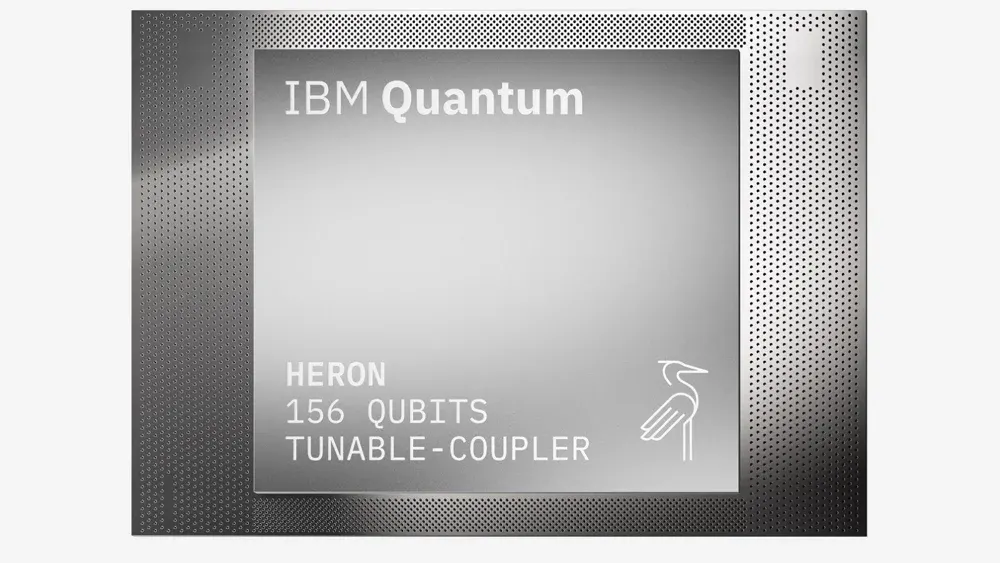
Image: IBM’s 156-qubit Heron (R2) superconducting processor (built in 2024) – an evolution of last year’s 133-qubit Heron (R1). Heron R2 doubled its two-qubit gate length to 5,000 gates, and ran select algorithms 50× faster than before. It also achieved industry-leading coherence and error rates for its size.
IBM announced Heron R2 in late 2024 as part of its quantum roadmap. The R2 device uses 156 transmon qubits arranged on a single chip, each carefully tuned for high-fidelity gates. In benchmarks, Heron executed a complex chemistry simulation 2.2 hours vs 112 hours on the prior chip – roughly 50× speed-up. This was possible because IBM focused on reducing gate errors and improving qubit coherence, not just adding qubits. Combined with software advances (the Qiskit platform), Heron supports circuits with thousands of entangling gates, enabling more ambitious algorithms.
IBM also detailed Quantum System Two, a rack-scale quantum computer containing three Heron processors, as a step toward 1000-qubit systems. While no full-scale quantum computer is ready, Heron shows that superconducting chips can scale up with modest gains in error, making serious simulations imaginable in the near future.
Quantinuum’s H2 Quantum System
Quantinuum (spin-off of Honeywell) continued improving its System Model H2, a trapped-ion quantum computer. H2 uses ytterbium ions in a “racetrack” trap design with all-to-all connectivity. In early 2024, Quantinuum revealed H2 with 32 qubits, up from the prior 10–12 qubits of earlier models. It demonstrated record-breaking entanglement and coherence: two-qubit gate fidelity reached ~99.9% across the entire 32-qubit array.
Importantly, Quantinuum used H2 to make progress on logical qubits. In April 2024 they teamed with Microsoft Research to apply quantum “virtualization” (an error-suppression technique) on H2, achieving logical qubit error rates 800× lower than the raw physical rate. This means H2 became (for now) the “highest-performing” quantum computer, by a published margin. Also in mid-2024, Quantinuum introduced H2-1, an upgraded version with 56 qubits. H2-1 set a new record: it executed a random-circuit-sampling task 100× faster (in fidelity) than Google’s 2019 Sycamore result, all while using far less power. This was possible because every qubit on H2-1 is fully connected, so quantum information can be routed optimally across the chip.
In summary, Quantinuum’s H2 system (trapped-ion) stands out for qubit quality: very long coherence times and nearly all-to-all gates. It has shown how logical error correction can dramatically reduce errors, and its performance on benchmarks suggests trapped ions will lead in the coming years.
Advances in Quantum Error Correction (QEC)
Quantum Error Correction is the holy grail of the field. QEC schemes encode a logical qubit into many physical qubits so errors can be detected and fixed faster than they accumulate. In 2024, real-time QEC moved from theory to demonstration:
- Below Threshold Error Scaling: Google’s Willow provided the first demonstration of “below threshold” operation in a superconducting system. By expanding the encoded lattice from 3×3 to 7×7, researchers saw the error rate halve as qubit count rose. This exponential error suppression was a decades-old goal – showing that adding qubits can improve rather than worsen overall fidelity.
- Logical Qubits on Hardware: The Microsoft-Quantinuum collaboration on H2 effectively created a tiny logical qubit with far lower error. Using their approach, they demonstrated 800× reduced error rates on an encoded qubit, bringing fault-tolerance closer. This proves that, with the right architecture, building a “good” logical qubit is feasible even with today’s noisy hardware.
- Error-Mitigation Algorithms: IBM and partners deployed advanced error-mitigation routines as a stopgap. For example, IBM partnered with Algorithmiq and others to run circuits with up to 5,000 entangling gates by smart classical post-processing. These methods don’t fix errors via hardware, but they statistically extract useful results from noisy runs, greatly extending circuit depth in practice.
In short, 2024 moved QEC from blue-sky to lab reality. While fully fault-tolerant machines (with millions of qubits) are still years away, these milestones prove the concept works: errors can be tracked and suppressed as a system grows. This closes a major gap between experimental devices and theoretically useful quantum computers.
New Quantum Hardware Architectures
Beyond raw qubit counts, 2024 explored diverse hardware types for quantum computers:
- Superconducting Qubits: This remains the mainstream (used by Google, IBM, Rigetti, etc.). These chips, cooled to millikelvin, implement qubits via Josephson junctions. Advances focused on better fabrication and control. For instance, IBM’s chips switched to new packaging that reduces crosstalk, and Google improved its fabrication lines to make more uniform qubits. The trend is fewer but higher-quality qubits. Google’s 105-qubit Willow and IBM’s 156-qubit Heron both emphasize gate fidelity and coherence.
- Neutral Atom Systems: Companies like Atom Computing and QuEra continued to refine neutral-atom quantum computers. These systems trap individual atoms in optical lattices or tweezers and use Rydberg interactions for gates. Notably, in Nov 2024 Microsoft/Atom announced 24 entangled logical qubits built from a few hundred physical Rydberg atoms. They achieved ~99.6% two-qubit gate fidelity – a record for neutral atoms. Neutral-atom QCs naturally offer all-to-all connectivity (since lasers can target any atom) and long coherence. The flip side is gates are slower (~10s of μs) and error rates somewhat higher than superconducting. But these systems scale up: QuEra and ColdQuanta are ramping toward thousands of trapped atoms. If they reach error-correction thresholds, neutral-atom could host large logical qubit arrays.
- Optical (Photonic) Quantum Computing: Photonics takes a different approach: using light (photons) as qubits. This can avoid cryogenics and benefit from ultrafast speeds. In 2024, several labs showed proof-of-concept photonic processors. A notable result: researchers in the UK (Nature Photonics 2024) created spatially-encoded cluster states of 9+ photonic qubits at 100 Hz. These high-dimensional cluster states let one perform measurement-based quantum computing quickly. The work suggested photonic quantum computers can perform gates and feedforward (decision-making) in real time, vastly speeding up certain calculations. Separately, in late 2025 China revealed a new photonic chip (TFLN – thin-film lithium niobate) with dense integration. It claims to 1000× accelerate some computations compared to GPUs. While these claims depend on the task, they signal that photonics is maturing: co-packaging of lasers, optics and electronics on wafers is now possible. Photonic quantum systems promise huge parallelism (many photons per pulse) and room-temperature operation, making them attractive for future scaled-up QCs.
- Other Modalities: Less publicized are things like silicon-spin qubits, neutral atoms at telecom wavelengths, or Majorana-based topological qubits. Some startups and labs are working on these exotic platforms, but they have not yet shown the headline milestones of 2024. For now, the field expects multiple modalities: one analysis notes “quantum computing’s future likely involves multiple coexisting hardware modalities, each optimized for specific applications”.
Artificial Intelligence in Quantum Research
AI and ML are accelerating quantum progress both ways: using classical AI to improve quantum and anticipating quantum’s role in AI. In 2024:
- AI for Quantum: Industry leaders built AI tools into the quantum workflow. For example, IBM introduced Qiskit Code Assistant, a generative AI tool that writes quantum code based on natural-language prompts. Similarly, Qiskit’s transpiler uses ML to optimize circuits, and libraries like Q-CTRL offer AI-driven pulse calibration. Microsoft and Google are exploring reinforcement-learning and hybrid quantum-classical neural nets to design better algorithms and error-correcting circuits. Researchers use neural nets to predict optimal qubit bias, tune laser pulses, and even mitigate errors on the fly. AI has also helped in quantum chemistry: ML-accelerated quantum simulation methods (like using neural-network quantum states) saw progress in simulating molecules.
- Quantum for AI: On the flip side, 2024 saw more experiments in quantum machine learning (QML). While still nascent, scientists ran small-scale quantum-enhanced classifiers and generative models on the new hardware. For instance, IBM and Cambridge collaborated on a quantum Boltzmann machine for optimizing portfolios (running on Heron), showing modest speed-ups in finding optimal asset allocations. Google researchers developed hybrid quantum-classical neural networks on Sycamore and Willow chips, demonstrating that certain unsupervised learning tasks can be sped up (although classical analogues exist). These QML demonstrations mostly use small noisy circuits, but they point toward future “quantum AI accelerators” for tasks like pattern recognition and combinatorial optimization.
Overall, 2024’s trend is synergy: classical AI helps quantum computers get built and used, while small-scale quantum processors begin aiding AI workloads. (True “quantum brain” is still far off, but the integration path is clearer.)
Post-Quantum Cryptography and Security
A big security theme in 2024 was preparing for quantum attacks. Quantum computers running Shor’s algorithm can break RSA or ECC encryption, so agencies have accelerated work on quantum-safe encryption:
- NIST Standards: In August 2024, the US NIST finalized its first suite of post-quantum cryptography (PQC) standards. This includes new algorithms (lattice-based, etc.) for public-key encryption and digital signatures that are believed resistant to quantum attacks. NIST urges organizations to begin transitioning to these algorithms now. This move was a watershed: it means that governments recognize quantum computers will soon endanger our current internet security.
- Industry Adoption: After NIST’s announcement, many tech companies pledged to update products. For example, cloud providers now offer PQC key exchanges (like CRYSTALS-Kyber) for securing VPNs, and financial services plan to roll out PQC signatures (e.g. Dilithium) by 2025. Hardware security modules and browsers are also being updated.
- Quantum-Resistant Algorithms: The essence of PQC is using mathematical problems (lattices, codes, hashes) that quantum algorithms can’t easily solve. In practice, this means doubling key lengths and changing protocols. The new standards will protect email, e-commerce, and any digital signature systems against future quantum decryption.
- Quantum Cryptography (QKD): Separately, advanced cryptography research continues on quantum key distribution (QKD) – using quantum mechanics for secure key sharing. While QKD isn’t mainstream yet, 2024 saw record distances (over 600 km optical link in China) and commercialization trials (bank transactions, satellite QKD). However, PQC is the nearer-term solution for most organizations.
In summary, 2024 closed the loop on a major security concern: quantum computers can break today’s encryption, so new standards are here to replace them. Experts stress that governments and businesses should start upgrading now, to be ready when practical quantum computers arrive.
Real-World Applications of Quantum Computing
Though still experimental, quantum computing already shows promise in several industries:
- Drug Discovery: Quantum simulators can model molecular structures more precisely than classical computers. In 2024, researchers demonstrated that quantum annealers (like D-Wave’s) could generate drug-like molecules orders of magnitude faster than before. One study (Jan 2026) used PolarisQB’s quantum platform to design thrombin-inhibitor candidates in ~30 minutes – a task that took classical AI ~40 hours for similar results. In practice, this means new drug leads could be found in weeks instead of years. Pharmaceutical companies (e.g. Roche, Biogen) expanded partnerships with quantum startups to screen compounds.
- Materials Science: Quantum computers simulate materials’ quantum behavior. New materials (e.g. superconductors, catalysts, batteries) involve solving complex quantum interactions. In 2024, IBM and Oak Ridge ran one of the first quantum-classical hybrid simulations of a chemical reaction, showing improvements over pure classical methods. Google’s Quantum Echoes algorithm (2025) targeted molecule geometry using NMR data – hinting at applications in chemistry. Quantinuum explicitly mentions “materials discovery” as a focus. Academics used small QCs to study high-temperature superconductivity and solar-cell molecules, finding insights that classical models missed.
- Artificial Intelligence & Optimization: Many optimization problems (scheduling, portfolio optimization, machine learning hyperparameters) benefit from quantum speed-ups. Banks and logistics companies ran pilot programs using quantum-inspired and quantum-assisted optimizers. For example, a major bank used D-Wave’s annealer to rebalance its portfolio overnight, achieving slightly better risk-adjusted returns. In machine learning, some teams used quantum kernels to train support vector machines on small datasets, and saw improved generalization. These use-cases are still niche, but they demonstrate quantum’s potential in data science.
- Climate Modeling: This is an emerging area. Climate and weather models involve solving huge coupled equations (fluid dynamics, radiation transport). Researchers at DOE and NOAA explored whether quantum algorithms (like QAOA or quantum Monte Carlo) could speed up parts of climate simulation. In 2024 no definitive quantum weather model appeared, but the idea gained traction: small quantum simulators tackled simplified models (e.g. aerosol chemistry, ocean eddies) to validate algorithms. In the future, QC might help simulate complex climate scenarios (like “butterfly effect” sensitivity) that classical models struggle with.
- Cryptography & Security: Beyond PQC, quantum devices could create ultra-secure communications via QKD (as noted) or simulate hard-to-break cryptographic primitives. While breaking encryption is a concern, another side is using QC to strengthen security – for instance, generating certified random numbers for cryptography or running quantum-resistant signature schemes faster.
Each of these domains is in early stages. Current quantum computers are too small for industrial-scale problems. But 2024 saw proofs-of-concept and pilot projects in these areas. The examples above show that quantum can speed up specific tasks (molecule generation, circuit optimization) by factors of 10–100 or more. As machines improve, we expect more practical advantages – for instance, designing a new vaccine or alloy that would be infeasible without quantum simulation.
Challenges That Still Remain
Despite the excitement, key obstacles persist:
- High Error Rates: Qubits still decohere quickly, and gate operations introduce noise. While error suppression techniques improved, fully fault-tolerant operation (like error-free logical qubits) remains out of reach. Most algorithms must run on noisy hardware with error mitigation. In practice, this means only short or specially structured circuits work today. IBM’s reports of 5000-gate circuits are milestones, but truly scaling thousands or millions of gates without noise is still a future goal.
- Complex Infrastructure: Quantum hardware is delicate. Superconducting qubits require dilution refrigerators at ~15 mK; trapped ions need ultra-high vacuum and precision lasers; neutral atoms need stable optical traps at microkelvin. This complexity means quantum computers are huge lab machines, not desktops. Building and maintaining them is expensive (tens of millions of dollars). Access is mainly via cloud. As systems grow, engineering challenges multiply (control wiring, cryogenics, vibration isolation). Many companies are investing in specialized factories and tools to ease this, but deploying large-scale quantum in everyday environments (data centers or research labs) is nontrivial.
- Limited Software Ecosystem: Programming quantum computers is still hard. There are only a few programming frameworks (Qiskit, Cirq, Q#, etc.), and developers need deep knowledge of quantum theory. Debugging is nearly impossible because measuring qubits collapses them. There are few high-level tools to automate algorithm design or error correction. However, 2024 saw growth: IBM, Amazon, and Microsoft released new SDKs and compilers; startups like Classiq and Q-CTRL offered algorithm synthesis; communities released libraries of quantum routines for chemistry, finance, etc. Despite this, the software stack is nowhere near as mature as classical computing’s, and finding talent (developers and theorists) remains tough.
- Scale and Speed: We need a lot more qubits to solve big problems. Current leaders are in the hundreds of qubits (e.g. Google’s 105, IBM’s 156, Quantinuum’s 56). Useful quantum advantage on real industrial problems probably requires thousands or millions of logical qubits. Engineering that scale will take years of work. Furthermore, some quantum gates are very slow compared to classical CPU cycles (neutral atom gates are microseconds, while a CPU does operations in nanoseconds). Speeding up clock rates or creating clever parallel algorithms is an ongoing challenge.
- Cost and Resources: Building and running quantum computers is resource-intensive. Google points out a 30,000× reduction in power for a quantum task vs classical, but that’s for the computation itself. The full infrastructure (cryogenics, lasers, control electronics) still consumes significant power. At present, quantum advantage often comes with huge overhead. Only with further integration and engineering will the net energy/cost efficiency become favorable.
Despite these hurdles, progress in 2024 indicates a clear roadmap. Each year sees better qubits, more automation, and growing industry interest. What was science fiction 15 years ago (like five-qubit codes) is now a reality. But we should remain realistic: practical, general-purpose quantum computers (ones you plug any problem into and get huge speedups) are still a decade away. In the meantime, hybrid quantum-classical systems and specialized quantum co-processors will drive incremental gains.
What the Future of Quantum Computing Looks Like
Experts are optimistic but measured. The consensus is that multiple quantum technologies will coexist and complement each other. Superconducting qubits (Google, IBM) will continue evolving – we’ll likely see ~1000-qubit devices by late 2020s and maybe ~10,000 by early 2030s. Neutral atoms and trapped ions could each field machines with comparable qubit counts but better connectivity and stability. Photonic and silicon-spin platforms might excel in niche tasks (like quantum communication or integration with classical chips).
In the software realm, quantum and classical computing will merge. IBM’s concept of “quantum-centric supercomputing” – tightly linking QPUs to classical supercomputers – will spread. This means future supercomputers might have quantum accelerators like GPUs today. Early versions exist (Riken in Japan couples Fugaku supercomputer to an IBM Heron), and we’ll see more of this integration.
Practically, the first commercial quantum applications are expected within 5–10 years in areas like drug design, finance optimization, and materials R&D. We already see companies offering “quantum as a service” for solving specific problems (vehicle routing, portfolio risk) using near-term QCs. As algorithms improve, we should get reliably better solutions for some optimization and simulation problems.
In terms of broader impact, governments and industries will keep ramping up quantum investment. Quantum-safe cryptography will become mainstream, quantum accelerators will join AI in data centers, and quantum sensors (like the ultra-precise optical clocks mentioned earlier) will open new possibilities in metrology and navigation. (For example, a quantum clock with 10<sup>‑19</sup> stability is essentially an exact ruler for time and frequency; such tech is on the horizon thanks to quantum research.)
In short, the future is hybrid and incremental: combining quantum and classical systems, and growing step-by-step. The field is not “just one giant leap” but many smaller leaps that together will transform computing. We’re entering an era where quantum computers are part of a larger ecosystem – integrated into clouds, labs, and networks – rather than stand-alone curiosities.
Common Myths about Quantum Computing
- Myth: Quantum computers are just faster PCs.
Fact: Quantum machines don’t replace classical computers; they excel at specific tasks where quantum physics offers an advantage. For ordinary tasks (web browsing, word processing), a quantum computer would not help. They coexist: quantum processors will act like special-purpose accelerators (as GPUs do today), not as universal PC replacements. - Myth: Quantum supremacy means instant super-power.
Fact: “Quantum supremacy” or “advantage” refers to outperforming classical computers on one specific task, often contrived. It does not mean quantum computers solve everything instantly. In 2019–2025, we saw supremacy on special benchmarks (like random circuit sampling), but those tasks have little practical use. Real-world quantum advantage (e.g. drug discovery, optimization) is still in progress. - Myth: Quantum computers will break all encryption tomorrow.
Fact: It’s true that a big enough quantum computer could run Shor’s algorithm and crack RSA/ECC. But current devices are far too small (hundreds of noisy qubits) to factor large numbers. Breaking typical encryption might require millions of fault-tolerant qubits, decades away. Meanwhile, standards agencies have released quantum-safe algorithms. So while it’s a serious long-term concern, it’s not an imminent disaster – we have time to transition. - Myth: It’s all theoretical; nothing works yet.
Fact: While still early, many elements of quantum computing do work and show clear benefits. The breakthroughs of 2024 (Willow, Heron, H2) are real hardware performing nontrivial calculations faster or more accurately than classical counterparts. Companies already offer quantum services in the cloud to paying customers. The hype often overlooks the solid progress made in labs. - Myth: One qubit is like one classical bit, so 1,000 qubits = 1,000 bits.
Fact: A single qubit can represent far more states than a classical bit, due to superposition. However, qubits are not simple “parallel bits” either – you cannot read all that information out at once. Moreover, adding qubits is challenging because errors grow. So while increasing qubit count is important, what really matters is coherence and error control. A smaller quantum processor with very stable qubits can outperform a larger noisy one. Quality over quantity has been the trend in 2024.
Overall, skepticism is healthy, but the technical milestones cited here show quantum computing is real and progressing rapidly. Debunking these myths helps set realistic expectations for the technology’s capabilities and timeline.
People Also Ask (FAQ)
Q: What are the latest breakthroughs in quantum computing 2024?
A: In 2024, quantum computing achieved several key milestones. Major breakthroughs include new high-qubit processors (Google’s 105-qubit Willow, IBM’s 156-qubit Heron, Quantinuum’s 56-qubit H2 with all-to-all connectivity) that outperform previous chips. Crucially, practical error correction was demonstrated: Google showed error rates decreasing as qubit arrays grow, and logical qubits with much lower error were created using trapped ions. New architectures (neutral atoms, photonic qubits) and AI-driven software were also deployed. Together these advances moved QC from lab demos toward commercial viability. Key papers and announcements (like the Google, IBM, and Quantinuum blogs) document these 2024 achievements.
Q: What is quantum error correction?
A: Quantum error correction (QEC) is a set of techniques to detect and fix errors in a quantum computer. Qubits are very fragile – interactions with the environment or imperfect gates can flip a qubit or lose its quantum state. QEC works by encoding a logical qubit into a block of many physical qubits. By cleverly measuring certain qubit combinations (syndromes) without collapsing the encoded quantum information, one can discover if an error occurred and correct it in real time. 2024 saw practical progress: Google’s Willow chip implemented surface-code QEC and showed that adding more qubits actually halved the error rate. Also, experiments with trapped-ion and neutral-atom systems produced logical qubits whose error rates were orders of magnitude lower than the raw hardware rate. QEC is crucial because it’s the only path to scaling quantum computers beyond a few error-prone qubits.
Q: What is Google’s Willow quantum chip?
A: The Willow chip is Google Quantum AI’s newest superconducting processor (announced Dec 2024) with 105 qubits. Built in Google’s own fabrication facility, Willow boasts two breakthroughs: it can exponentially suppress errors as qubit count increases, and it ran a benchmark task (random circuit sampling) in under 5 minutes – a task a classical supercomputer would take ~10<sup>25</sup> years to match. Willow uses a 2D grid of qubits (surface code) for logical encoding, and it achieved a “below-threshold” error-correction regime (meaning logical errors drop as you scale up). Google claims Willow is now state-of-the-art in both speed and error-rate metrics. In short, Willow is the fastest, most accurate quantum chip Google has built, paving the way to real-world quantum applications.
Q: What is IBM’s Heron processor?
A: IBM’s Heron is the name of a quantum processor family. In 2024, IBM released Heron (R2), a 156-qubit superconducting chip. This was an upgrade to the previous year’s 133-qubit Heron (R1). The R2 Heron can perform 5,000 two-qubit gate operations, double the previous limit, and runs certain algorithms 50× faster than R1. IBM’s announcements highlight that Heron R2 achieved significantly better error rates and coherence. It also launched alongside Qiskit software updates (like AI-driven circuit optimizers) to fully utilize its performance. The Heron processor is available on IBM’s cloud quantum service, and it helped IBM claim new benchmarks in circuit depth and qubit reliability for superconducting systems.
Q: What is Quantinuum’s H2 quantum computer?
A: Quantinuum’s System Model H2 is a trapped-ion quantum computer (Ytterbium ions) with an innovative “racetrack” trap design. The initial H2 (launched 2023) had 32 fully-connected qubits; by mid-2024 they expanded it to 56 qubits (called H2-1). H2’s key features are that every qubit interacts with every other (all-to-all connectivity) and that gate operations are extremely high fidelity (~99.9%). In 2024, H2-1 ran a sampling benchmark 100× better (lower error) than Google’s 2019 experiment, showing its raw power. Quantinuum also demonstrated topological “anyons” on H2 (a step toward fault-tolerant schemes). In short, H2 is currently the highest-performing quantum computer in terms of fidelity and connectivity; it is used by Quantinuum and partners (like Microsoft) for advanced research in error correction and logical qubits.
Q: What are real-world applications of quantum computing?
A: Quantum computing’s real-world uses are emerging. Key application areas include:
- Drug discovery & chemistry: Quantum simulators can model molecules much more precisely. In 2024, quantum annealers were used to design drug candidates dramatically faster than before, and hybrid quantum algorithms are being tested for catalysts, reaction pathways, etc.
- Materials & nanotechnology: Quantum computers can predict new materials (superconductors, batteries). Projects are underway to use QC to screen candidate compounds for desirable properties that are intractable to simulate classically.
- Optimization & AI: Banks and logistic firms use quantum- or quantum-inspired algorithms to optimize portfolios, routes, and supply chains. Initial studies showed modest gains over classical methods. Research in quantum machine learning may accelerate data analysis and AI training in the future.
- Climate & Energy: Early research investigates using QC for climate models (complex PDEs, weather prediction) and energy grid optimization. It’s still theoretical, but even partial speed-ups in these simulations could help with modeling climate change and optimizing renewable power.
In 2024 most applications are pilot studies or proofs of concept. But the successful demonstrations (e.g. faster molecular simulations and improved optimization runs) indicate quantum computing is moving from pure research to tackling practical problems. Over the next 5–10 years we expect niche quantum solutions to begin yielding business value in these areas.
Q: What challenges still remain for quantum computing?
A: Several hurdles remain before quantum computers are ubiquitous: high error rates, complex hardware requirements, and software limitations. Current qubits are noisy – errors are orders of magnitude higher than in classical bits – so most algorithms need error mitigation or work only on short circuits. Building quantum hardware requires cryogenics, ultra-high vacuum, and precise control systems, making machines large and costly. Also, there’s a shortage of quantum software tools and skilled developers, which slows adoption. Even with the 2024 improvements, scaling from hundreds to thousands of reliable logical qubits is a major engineering challenge. In addition, integrating quantum computers with existing IT (security, workflow, databases) is still an open problem. Researchers worldwide are addressing these issues, but the consensus is that fully error-corrected, general-purpose quantum computers will take several more years (if not a decade) to arrive.
Q: What is post-quantum cryptography?
A: Post-quantum cryptography (PQC) refers to new cryptographic algorithms designed to be secure against quantum attacks. Because large quantum computers can run Shor’s algorithm to factor RSA keys, governments and industry have been preparing by standardizing quantum-safe encryption. In 2024, NIST finalized its first PQC standards (algorithms like CRYSTALS-Kyber and -Dilithium). These schemes rely on hard mathematical problems (lattices, codes) that even a quantum computer cannot solve efficiently. Systems that implement PQC (web protocols, email, etc.) will remain secure in the quantum era. Organizations are already updating software stacks and hardware to use these new algorithms – for example, web browsers and cloud services now support quantum-resistant key exchanges. In summary, post-quantum cryptography is the quantum-safe replacement for today’s public-key encryption; it ensures our data remains protected even once powerful quantum computers arrive.